

THE LAND BEFORE TIME
what should you do when you're still writing the book, but you're an overachieving type-A personality and want to go ahead and start thinking years ahead about publicity.

I’ve been thinking about how all my attention lately is being sucked into the future: Summer House reunion, cyanide wilderness bombs, 401k savings, the negotiation of dyeing gray hair or letting it happen, booking an oil change, the dog’s annual vet visit, will my kid like an all-day summer camp, did I buy enough for their teachers end of year, when will the baby sit up? My present is constructing emails, typing ideas into my notes apps: “writing soul care,” “the line between humble and braggadocious,” etc. etc. etc. Crying over a video watching a mom make her last school lunch ever (Not a thing I have ever thought about). The life in my body is suffering through a split squat, while my mind is in October with Kristen Millares Young’s memoir DESIRE LINES. Everything feels like a split screen. What is presence (I’ve never been good at meditation).
And then I got to join Lilly Dancyger lovely class for a chat about platform Thursday afternoon, and I got to thinking about scaling it all back to one simple question: what should I be doing before it all starts? People will tell you that when you’re working on a book, you shouldn’t think about audience at all. And then Jill Christman will tell you that she wrote her most recent book, THE HEART FOLDS EARLY, with everyone in the trunk of the car. A clown car and a choice. It was the decision to overturn Roe v. Wade that set her to writing again—to those specific pages. Everyone was watching over her shoulder, and that enhanced the voice of the book too: she speaks directly to the reader, breaking the fourth wall, which I hadn’t experienced in memoir in a long while. (Maybe since Chronology of Water?) But for her, the book was a spectator sport from the beginning of a new draft.
And there are things you could be doing for your future self before there is even a publicity campaign to plan, so: what should you be doing (about publicity) while you’re writing the book—if you can live in the split screen with the self who is writing and the self who will one day publish. If it feels, like me, that you have seventeen Medusa heads hissing out of sync, then this could be a thoughtful exercise. Sometimes it’s nice to get things down and off the bone china plate of the brain.
People, places, things lists. I’ve had authors do this many times on publicity cycles. Literally keep lists of the people, the places, and the things in the book. My friend Ashley who always pretended to smoke her chapstick, Burger King on Miami Blvd, that “Shoes The Full Version” from Liam Kyle Sullivan from NINETEEN YEARS AGO. My god, I’m old. (See what I mean by seven medusa heads). Also, are these three things an essay, wait to find out. But seriously, if there’s a celebrity named in your novel, a moment of cultural relevance, a historical date, or your memoir has four song titles, or your poetry collection references Real Housewives (shout out to Chrissy Martin and WHOLE HOLY HOT), then you add those to the lists. If there’s atmospheric scene mentions, but not the literal place—add it to the list. If there’s an era or a homage or an allusion, add those to the list.
To go along with these lists: keep a folder of miscellany. Memes, screenshots of threads, links to headlines that match the vibe of your book or align with something you’re attempting to say, links to Substack notes or Substacks. Start a collection of ephemera for your book and you are the keeper of the keys.
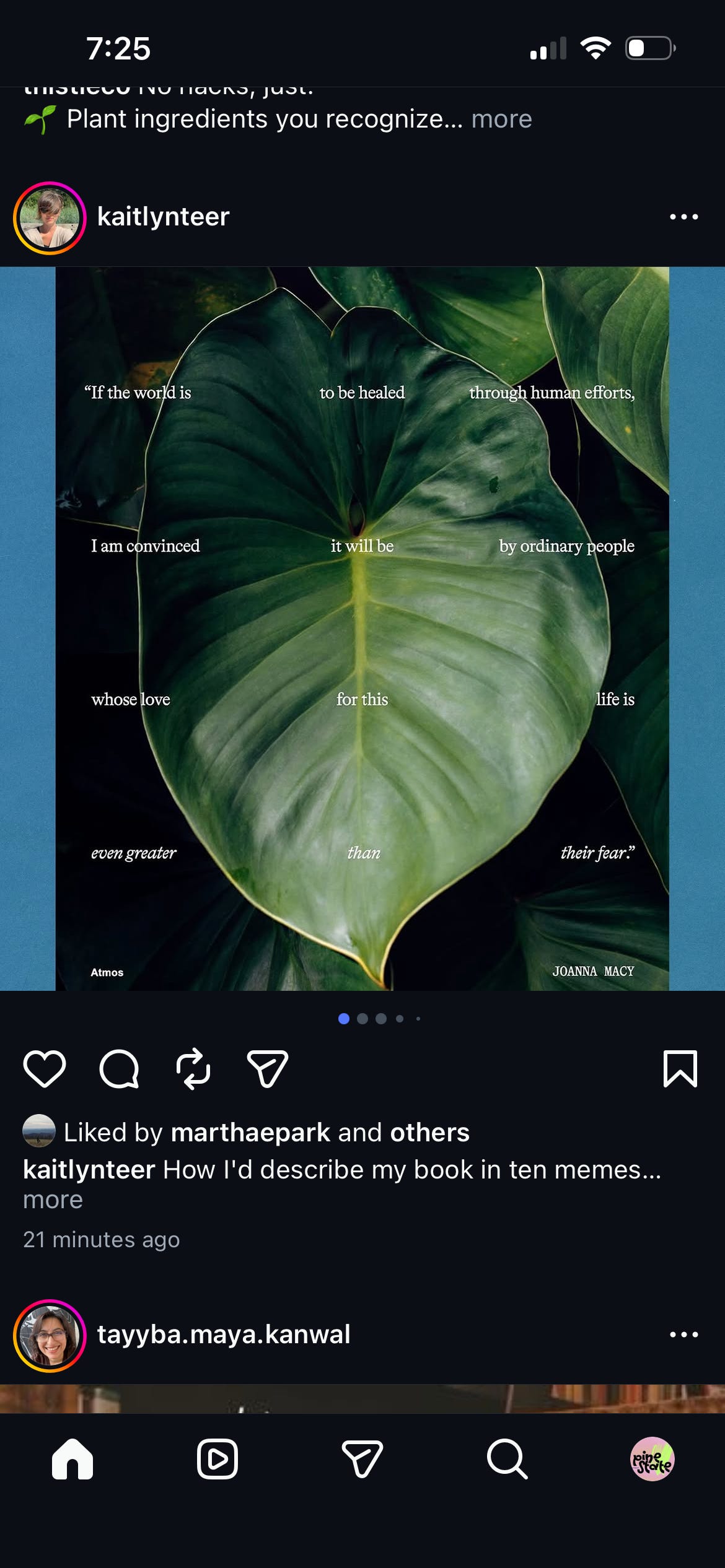
March 4 I saved this screenshot of Kaitlyn Teer “my book in ten memes” to my phone apparently for future Pine State posts. Get her new book Little Apocalypses! (I did not work on it, I just love it!).
Start (if you don’t already) talking about other books. I’ve been recommending this for forever, but if you want to bulk up your publications at higher tier places, write book reviews. Then, in your query, you can say, “I was published in Ploughshares, Paris Review, and Bookforum.” No one is looking to see what you published at each of those places. Less formally, start talking about books on your social media platform of choice (this can also be Goodreads). Tag the authors (in KIND posts about their books that do not have star ratings! A four star can put someone write over the edge in the throes of a publicity campaign—should I write about emotional management during book publicity?). Start getting your name and your interests out there. Sharing what you love is a great way to build community.
Save all your scraps. If you’ve killed some darlings, I hope that they’re in a folder. That story you cut, save it. That line that was your favorite but didn’t fit the manuscript. That first memoir that you never ended up selling. All of that can be both publicity fodder and reshaped into publicity action.
Choose your player. You don’t have to be on every social media, you don’t have to perform on social media. You don’t have to find our niche marketing skill, but you can—at this stage—consider where to start putting energy in a social media landscape. Do you like video and speaking to people? Tiktok. Instagram. A podcast on Substack. Do you prefer longform writing and have something to say beyond your book project? Substack. Tapas of writing? Bluesky. Threads. Build community SOMEWHERE. It can be anywhere.
Become a regular at your local(ist) bookstore.
I was just doing some air guitar work in my kitchen to “There’s Your Trouble” with headphones while I cleaned out the fridge, and this is a huge one: the art of the pivot. There is no one story to tell about a book, every reader is going to connect with something different (no matter if Kindle tells you 477 people highlighted this line—what does it say about me that I pride myself on NOT highlighting that line?) With the writing and then the revising and then the talking and then the querying and then the elevator pitch, writers can tend to get stuck in one idea of their novel. It’s a book about x. It’s a story about x. And that flattening of the narrative pulls can be detrimental to the breadth of publicity ideas. When you’re answering the same four interview questions over and over for different publications—how are you going to be both truthful and unique in each one. I like to talk to authors a lot about the audience of a publication—what will make them care about this book. Sometimes this is easy to define and sometimes it’s a generalized literary magazine (I turn to their social media for that work, but that’s beside the point). Instead of thinking about your book as a set piece of marketing copy or an elevator pitch on a stagnant stage, think of it as the many set pieces in a production, plus the blocking. How many different ways can you tell the story of this book. Reframe through the lens of another character. Reframe through a minor conflict. Reframe through language, and through audience. How might you tell your dad vs. your college sorority sisters (I had a suite of weirdos myself) vs. your favorite cashier at the pet store. What would you play up? What would you avoid? This gives you so much fodder for when the book explodes on the scene.
Start a mini-media list. I don’t need you to have three hundred journalists in a document, but if you’ve started a list of Substack folks who might be interested in your book, or you have a list of Bookstagrammers you’ve seen love other books, or you read a lot of x’s essays. These are good things to have, and they can be saved via osmosis really. Exist in the literary landscape and you can build this list, it isn’t about searching out these folks but noticing where you’re going, what you’re reading, what you’re scrolling.
Practice. When I was talking to Lilly’s class, I gave the idea of doing mini-diy practice campaigns (I never ever want to say “content,” bleh). That would look something like this: you publish an essay / story / poem somewhere, you use said piece several different ways to create more momentum from the ONE thing. Here’s a short example of what I can think of to create off the top of my head from one piece. Also, normalize making one piece THIS important. Writing is hard, publishing is hard, and we are allowed as much hallelujah as we can muster.
You post the publication.
You write a behind-the-scenes of the pitch.
You write a genesis story for the piece—where did it come from, how was it started, what was the germinating seed?
You write a how you wrote it (annotated?)—where were you? What lines came first? What line gave you trouble? What made it finally come together? Once you knew X, you could figure out D, J, L, and Q. Then, what happened?
You breakdown the choices in the opening line.
You do a “I could have said, but I chose ______” about a sticky line. Your favorite line. Whatever!
You make a post about the inspirations. What you were reading? What were you watching? What were you listening to on the way to school drop-off? What did you scroll by? What snuck into the piece that you weren’t expecting just from living your daily life?
You talk through your thoughts on submitting said piece. Where did you consider and why? What felt like a good magazine / market for the piece? Was it rejected at all at places? (I don’t think everyone wants to share rejections, but you might! Julia Marie Wade who I deeply respect as writer, always shares her!) How did you decide to send it to x magazine?
Title? How did you do it?
If the piece had epigraphs what would they be?
How long did it take to publish from writing to publication? Why so long / so short?
A miniature playlist for the piece. If you love these four songs, you’ll love this essay.
Shout out the editor? Shout out the friends along the way? Shout out the three day old coffee on your desk (okay, I promise I’m finished now).
Do yourself the favor, and learn some facets about publishing. This can be as simple as subscribing to Jane Friedman or as detailed as understanding the market share determined by having the right distributor. You don’t need to know the entire history of publishing, or the banana republic of it all, but you do need to understand where your book is fitting and what you’re writing. I’ve long said that what I was writing in graduate school, and what I always write, is never going to get published by a big four publisher. If I ever write a book, I’ll be taking my book and a suitcase over to some university presses and indie presses. I have a little wishlist. It helps you at every stage to understand what you’re doing and where in the publishing landscape you fit.
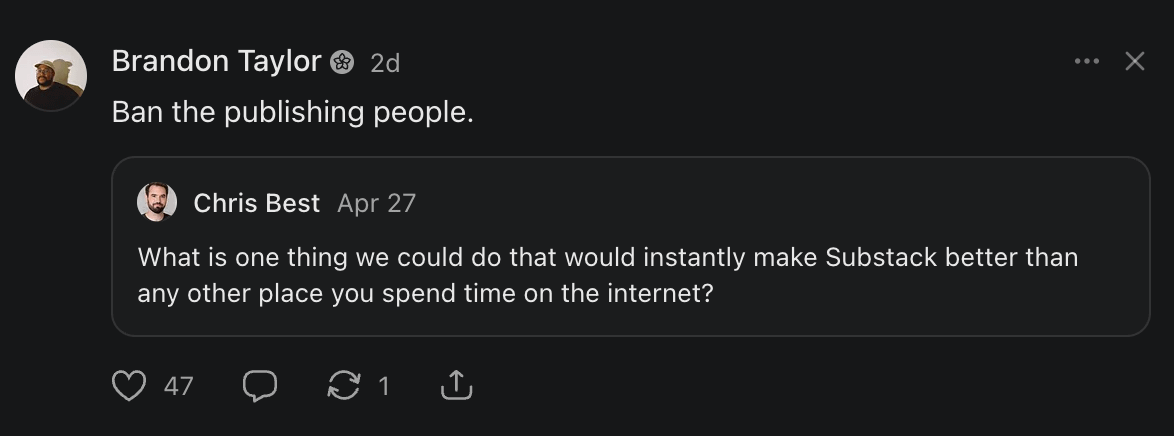
I am reading everything I just wrote with Brandon Taylor’s note in my head that Substack would be better if we could get rid of all the publishing folks, and y’all—sometimes I’m like, “on a scale of 1 to 10, am I a level 9 annoying right now?” It’s like Enneagram for highly anxious people.
ALERT ALERT! I am joining the good folks at AWP and The Writer’s Chronicle for a panel about promoting poetry, “TWC LIVE! Marketing Your Poetry Collection”. Sign-up! It’ll be Thursday, May 28 at 7pm E.T.
*
As always, the Pine State calendar of events lives here (which I need to update), and you can buy our books here! You can also see what we’re working on and contact us through our website, Pinestatepublicity.com.
J Brooke has a poem (and a moon!) from I CAN TELL YOU THE VERSION THAT WILL MAKE YOU TAKE MY SIDE in Hobart, Hasan Dudar was on Michigan Public Radio chatting CARRYOUT, Nicole Graev Lipson remains unforgettable with MOTHERS AND OTHER FICTIONAL CHARACTERS, Preeti Vangan talks FIFTY MOTHERS with The Rumpus, DELIVERY by Christopher Hebert is excerpted (with an old Pizza Hut lamp!) in Literary Hub and Pittsburgh Review of Books, this years in the making conversation with Lisa Russ Spaar and Lena Moses-Schmitt in Blackbird, a STAR for Rebecca Gayle Howell ERASE GENESIS, Aimee Souza Reilly is a Big Other finalist with HUMAN/ANIMAL, Diana Arterian won the William Carlos Williams Prize for AGRIPPINA THE YOUNGER, Christian Century goes there with Jill Christman’s THE HEART FOLDS EARLY, booksellers love Kate Crane and WHAT EVER HAPPENED TO EDDY CRANE? on WAMC, Monica Ferrell takes THE FUTURE to The New Yorker podcast, Strange Horizons drinks from Lauren K. Watel’s BOOK OF POTIONS (can’t believe I didn’t use this language in a pitch). and so much more on Twitter, Bluesky, & Instagram.
Great post! Also, try to add a few nuggets in your book that you can pull out later and use as an angle for a specific audience. For example, for my 2013 book One Big Happy Family, about interspecies animal adoption, my agent suggested I find a few examples of stories from France, Germany, and elsewhere to put in the book. I did, and we were able to sell foreign rights to the book to these countries. You could do the same thing in terms of angling publicity to specific markets.
Cassie this is all so good and brilliant and I am taking it to heart as I write my next book!!! Thank you!